
From Backyards to Deep Space: Astronomy Research Ideas and Student-Led Space Telescope Projects
Big discoveries don’t always need big budgets. With the right framework, students can turn curiosity into publishable insights that stretch from local skies to orbiting observatories. Begin with a clear question, a repeatable method, and datasets that scale. Today’s toolkit includes smartphone sensors, backyard scopes, public archives, and cloud notebooks. This is where strong astronomy research ideas converge with persistent data habits: document procedures, version-control code, and validate results with error bars instead of anecdotes. The payoff is not just a captivating result—it’s scientific literacy built on calibration, statistics, and reproducibility.
Ground-based projects brim with potential. Photometry enables tracking variable stars and plotting asteroid light curves to estimate rotation periods and shape models. With modest telescopes and a CCD or CMOS camera, students can time exoplanet transits to complement professional surveys like TESS, then compare curves against published ephemerides. Meteor spectroscopy with a diffraction grating can reveal elemental fingerprints, while light pollution mapping with sky-quality meters quantifies environmental change over seasons. Radio astronomy, using a low-cost software-defined radio, opens a window on the hydrogen line at 1420 MHz for galactic structure labs. Data handling becomes the core skill: plate solving, aperture photometry, and curve fitting with Python libraries such as Astropy and Pandas transform raw pixels into meaningful plots.
Going above the atmosphere, many student teams mine archival repositories for authentic Space Telescope Projects. The Mikulski Archive for Space Telescopes (MAST) hosts Hubble and TESS datasets ripe for new analyses—color-magnitude diagrams for open clusters, star-forming region morphologies, and transient searches across time-series imagery. Remote observatories like Las Cumbres Observatory and Skynet allow queued imaging from professional instruments; careful target selection and multi-night cadence transform single snapshots into time-domain science. Consider a capstone example: a student cohort analyzed Hubble archival data to compare cluster ages via isochrone fitting, then validated the results with Gaia parallaxes. Another team built a pipeline to cross-match supernova candidates from ZTF alerts and confirm photometric classifications. These authentic workflows harden skills in uncertainty quantification, peer review, and the art of asking better questions with each iteration.
Cognitive Science for High School: Experiments, Data, and AI Literacy
The human mind is a laboratory students carry everywhere. Well-designed studies can illuminate attention, memory, perception, and decision-making with modest equipment and rigorous ethics. Classic paradigms scale beautifully to classrooms: Stroop tasks to probe automaticity, change blindness to test visual awareness, working-memory span tasks, visual search to quantify reaction times, and mental rotation challenges for spatial reasoning. Using browser-based frameworks like jsPsych or simple timing in Google Forms, learners can pilot protocols, randomize trials, and collect reaction time distributions. Proper consent, anonymization, and debriefing are vital, along with a pre-registered hypothesis and clear exclusion criteria for data quality.
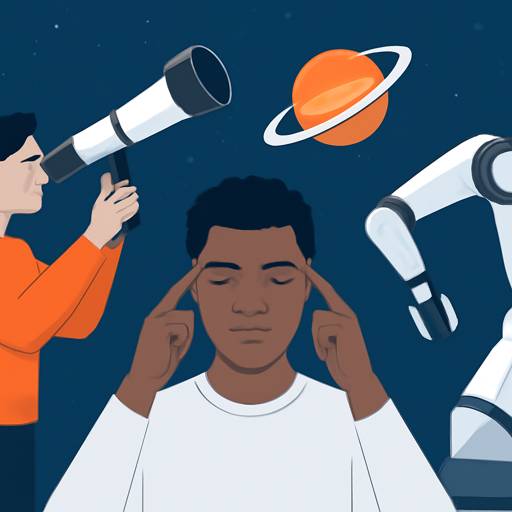
Strong cognitive science for high school work rests on transparent analysis. Students can compute means, medians, confidence intervals, and effect sizes, then visualize results with violin plots or kernel density estimates. Bootstrapping helps communicate uncertainty without heavy calculus. Power analysis guides sample sizes, while counterbalancing mitigates order effects. By building code notebooks in Python or R, learners practice repeatable analytics: import raw CSVs, clean outliers by pre-set rules, model results with simple linear mixed effects, and generate publication-ready figures. Interdisciplinary extensions come naturally—neuroscience modules can introduce EEG headsets for event-related potentials in basic oddball paradigms, and psychology modules can compare survey-based traits (e.g., grit, growth mindset) with task performance for correlational insights.
Case studies sharpen design thinking. A semester project might examine sleep’s role in sustained attention using a psychomotor vigilance task before and after varying sleep durations, controlling for caffeine and screen time. Another team could explore false memories with the Deese–Roediger–McDermott paradigm, quantifying lure recall and discussing implications for eyewitness testimony. In a computational twist, students might compare human patterns with simple AI agents, building a reinforcement learning model that emulates habit formation, then contrasting its learning curves with human practice effects. Ethical reflection remains central: avoid sensitive clinical topics without oversight, disclose limitations, and discuss generalizability. By anchoring research in transparent methods and empathy for participants, high schoolers learn to treat minds—human and artificial—as systems to understand, not to exploit.
Building the Future: Humanoid and Swarm Robotics for Students
Robotics compresses physics, coding, and design into a single, kinetic experience. For humanoid robotics for students, even a two- or four-degree-of-freedom arm can teach inverse kinematics, trajectory planning, and feedback control. Affordable servos plus microcontrollers (Arduino, ESP32) or single-board computers (Raspberry Pi) anchor the hardware stack; IMUs stabilize posture while simple force sensing protects gears during contact. Vision modules using OpenCV enable object detection and color tracking; speech interfaces add naturalistic interaction. Start with gait generation on flat terrain, using center-of-mass projections and PID control to maintain balance, then iterate with zero-moment point ideas at a conceptual level. Safety and reliability trump acrobatics: fuse limits in software, add compliant joints where possible, and maintain a repair log to capture failure modes and fixes.
Swarm projects cultivate systems thinking. A handful of small differential-drive bots—micro:bit rovers, ESP32 minis, or Tiny Whoop-class drones in a netted space—can demonstrate emergent behavior through simple rules: separation, alignment, and cohesion (the “boids” model). Leader–follower formations, consensus algorithms for shared decision-making, and market-based task allocation expose students to distributed control. Localization need not be exotic: AprilTags or ArUco markers yield pose estimates with a single camera; basic ultrawideband anchors or Bluetooth RSSI handle relative ranging. Communication can start with Wi‑Fi or Bluetooth mesh, evolving to ROS 2 for pub/sub messaging and modular autonomy. Simulators like Webots, CoppeliaSim, and PyBullet allow rapid iteration and safe debugging before deploying code to real robots.
Real-world examples help teams measure progress. One after-school group programmed ten palm-sized rovers to cooperatively map an unknown classroom layout. Each robot maintained a local occupancy grid, broadcasting updates via ROS 2 topics; a central server merged maps and computed global coverage. The students benchmarked performance using time-to-95% coverage and energy per mapped square meter, then improved results by tuning motion primitives and adding collision penalties to their reward functions. For inspiration, curated repositories of Swarm robotics student projects can seed brainstorming, from warehouse-style item retrieval to adaptive traffic simulations. Another team built a bipedal torso that stabilized under disturbances using a simple complementary filter and velocity-based control; they then layered a vision loop to grasp colored blocks, logging grasp success rates and cycle times. Whether the goal is elegant locomotion or a collective accomplishing more than any individual robot could, swarm and humanoid pathways both reward disciplined iteration: plan, simulate, test, and reflect.
